
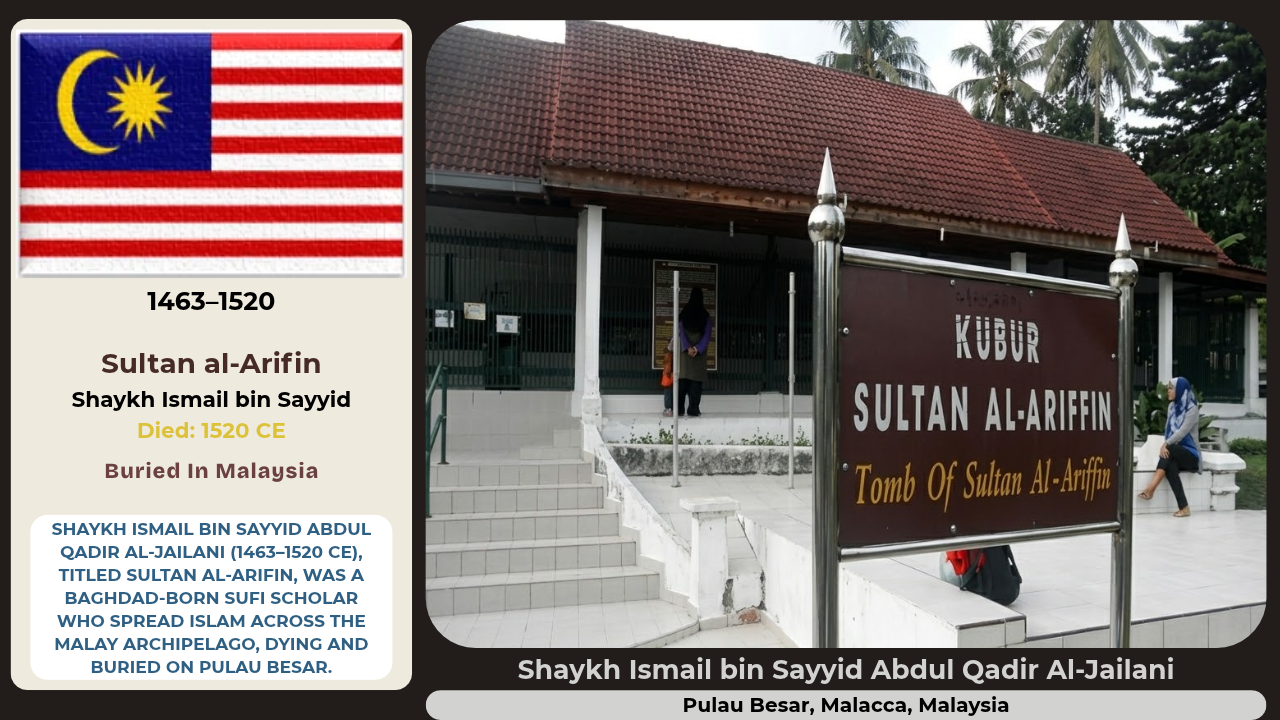
Makam Sultan Al-Arifin Syeikh Ismail biography


Sultan Al-Arifin Syeikh Ismail Burial Location
Makam Sultan Al-Arifin Syeikh Ismail Sufi Heritage of Pulau Besar Melaka
The Makam Sultan Al-Arifin, also known as the tomb of Syeikh Ismail, is one of the best-known traditional Islamic pilgrimage sites on Pulau Besar, off the coast of Melaka, Malaysia. The shrine is associated with the Sufi figure remembered locally as Sultan Al-Arifin, a title commonly understood as “the Sultan of the Gnostics” or “Master of the Knowers of God.”
The site is important not only as a place of visitation but also as part of Melaka’s wider history of Islamisation, maritime connections and local religious traditions. Its history, however, needs to be read carefully: accounts of Syeikh Ismail’s origins, genealogy, arrival in Melaka and relationship with other early Malay Muslim figures are preserved largely through traditional narratives, and not every detail can be independently confirmed by contemporary historical records.
Where Is the Makam Sultan Al-Arifin Located?
The Makam Sultan Al-Arifin is situated on Pulau Besar, an island in the Strait of Malacca, within the state of Melaka, Malaysia. The island lies off the coast of the mainland near Umbai and is administratively associated with the Melaka Tengah area.
Pulau Besar is approximately five kilometres from the Umbai jetty and around ten kilometres south of Melaka City. It is the largest island in the state of Melaka, with an area of approximately 168 hectares, according to a 2023 academic study.
The island can be reached by boat from the mainland. Services have traditionally operated from Jeti Anjung Batu and the Umbai area, with scheduled ferry services and private speedboat arrangements reported by researchers. Visitors should confirm current departure points, operating times, fares and sea conditions before travelling.
The tomb is a major historical and religious attraction on the island. It is also part of a wider landscape of traditional graves and sites associated with early Muslim preachers and local religious heritage.
Who Was Sultan Al-Arifin Syeikh Ismail?
Sultan Al-Arifin Syeikh Ismail is remembered in the religious traditions of Melaka as a Muslim scholar, Sufi preacher and missionary who helped spread Islamic teachings in the Malay world.
His honorific, Sultan Al-Arifin, is generally interpreted as a title referring to spiritual knowledge and recognition of God. It is not evidence that he ruled a political kingdom or held the formal position of a Malay sultan.
Academic publications discussing Pulau Besar identify him as Syeikh Ismail and associate his activities with the development of Islamic teaching and Sufism on the island. His reputation became closely connected with the island’s religious history, and his tomb remains the most prominent memorial associated with his name.
Name and Traditional Genealogy
A name frequently given in local and devotional accounts is Syeikh Ismail bin Sayyid Abdul Qadir bin Sayyid Abdul Jabbar. These accounts also describe him as a descendant of the Prophet Muhammad through Husayn ibn Ali.
Some traditions further identify him as a descendant of the celebrated Sufi master Abdul Qadir al-Jilani. Such genealogical claims are important to the religious memory surrounding the shrine, but a complete and independently verified chain of descent has not been established through contemporary documentation.
For historical writing, it is therefore more accurate to describe these relationships as traditional genealogical claims rather than confirmed facts.
Birth and Early Life
Local biographical accounts commonly place Syeikh Ismail’s birth in Baghdad on 17 Rabi al-Awwal 867 AH, corresponding to 1463 CE. His parents are traditionally identified as Sayyid Abdul Qadir and Sayyidah Fatimah.
These details appear in modern publications about Pulau Besar, but the available evidence does not provide the same level of independent contemporary documentation that would be expected for a securely established medieval biography.
Baghdad was an important centre of Islamic scholarship, religious learning and Sufi activity during the period. The tradition that Syeikh Ismail came from Baghdad reflects the wider historical connections between the Middle East and the Malay Archipelago through trade, travel and religious networks.
Syeikh Ismail’s Arrival on Pulau Besar
One of the central episodes in the traditional biography of Sultan Al-Arifin is his journey from the Middle East to Southeast Asia.
According to accounts discussed in modern research on Pulau Besar, Syeikh Ismail arrived on the island around 1495 CE, corresponding approximately to 900 AH. He is said to have travelled with a group of companions and religious figures, including Syeikh Yusuf al-Siddiq and his brother Syeikh Ibrahim.
A 2023 study by Muhammad Masruri and colleagues reports that the group consisted of approximately sixteen people. The same account places their arrival during the reign of Sultan Mahmud Shah of the Melaka Sultanate.
The story also relates that Syeikh Ismail travelled to Madinah to visit the Prophet’s Mosque and subsequently received an instruction, described in devotional tradition as a spiritual call, to spread Islam in the islands of Southeast Asia.
This account belongs to the religious tradition surrounding his life. It should not be treated as a contemporary travel record because independent documentation confirming the details of the journey has not been established.
Pulau Besar During the Melaka Sultanate
Pulau Besar occupied a useful geographical position near the busy maritime routes leading to the port of Melaka. During the Melaka Sultanate, ships travelling through the Strait of Malacca used the island and surrounding coastal areas for supplies, including fresh water, food and firewood.
Its proximity to the port made it a suitable location for religious teachers and travellers arriving from other parts of the Muslim world.
The island’s historical significance was therefore not limited to its religious associations. Its position within a major commercial maritime network also helped create opportunities for the exchange of ideas, languages, religious teachings and cultural practices.
The arrival of Muslim scholars and Sufi preachers is part of this wider history of interaction between the Middle East, South Asia and Southeast Asia.
Pulau Besar as a Centre of Islamic Learning and Sufism
Syeikh Ismail is associated with the establishment of a small settlement and religious learning centre on Pulau Besar. Modern academic studies describe this institution as a zawiyah or madrasah, where Islamic teachings and Sufi practices were transmitted.
A zawiyah traditionally served as a place for religious instruction, spiritual guidance, worship and the development of a community around a religious teacher. In the Malay world, such institutions helped introduce Islamic learning to communities beyond major urban centres and royal courts.
According to research published in Jurnal Al-Tamaddun in 2019, the activities of Sufi scholars such as Syeikh Ismail and Syeikh Yusuf contributed to the development of Islam on Pulau Besar. The study describes the island’s religious school as an important centre for learning and the wider dissemination of Islamic teachings.
The exact institutional structure, dates of construction and physical appearance of the original learning centre are not securely established. Nevertheless, the tradition of a religious settlement on Pulau Besar forms an important part of the island’s historical identity.
Sufi Teachings and Religious Activities
The traditional image of Syeikh Ismail is that of a religious teacher who emphasised Islamic faith, spiritual development and moral conduct.
The wider Sufi environment associated with Pulau Besar included religious instruction and the cultivation of Islamic values. These activities were part of a broader pattern in which travelling scholars and spiritual teachers established centres of learning throughout the Malay Archipelago.
Some modern accounts associate Syeikh Ismail with the Qadiriyya Sufi tradition, which takes its name from Abdul Qadir al-Jilani. This association is consistent with the genealogical and spiritual traditions surrounding his biography, although a detailed, independently documented chain of initiation has not been established.
It is therefore appropriate to describe him as a figure associated with the Sufi tradition of Pulau Besar while treating more specific claims about multiple formal Sufi affiliations cautiously.
Traditional Connections with Sunan Giri and Sunan Bonang
Syeikh Ismail is sometimes associated with two prominent figures in the history of Islam in Java: Sunan Giri and Sunan Bonang.
According to accounts repeated in modern writing about Pulau Besar, both are identified as students or figures influenced by the religious learning associated with Syeikh Ismail and the island’s wider scholarly environment.
Sunan Giri and Sunan Bonang are traditionally counted among the Wali Songo, the group of influential Muslim preachers associated with the spread of Islam in Java.
These connections are significant in the religious memory of the Malay-Indonesian world. However, the precise teacher-student relationships and the details of their alleged studies on Pulau Besar require careful treatment. The available accounts do not provide sufficient contemporary evidence to establish every claimed personal connection beyond doubt.
The broader historical point is that Melaka, Java and other parts of the Malay Archipelago were connected through maritime travel, religious scholarship and networks of Muslim preachers.
Death of Sultan Al-Arifin Syeikh Ismail
Traditional accounts place Syeikh Ismail’s death on Pulau Besar on 17 Rabi al-Awwal 925 AH. A modern academic study published in Sains Insani in 2023 gives the corresponding Gregorian date as 28 March 1519 CE and states that he was 58 years old.
The reported age is consistent with the traditional birth year of 867 AH when calculated using the lunar Islamic calendar. Gregorian conversions of Hijri dates can vary slightly, and other popular accounts sometimes give 1520 CE. The date should therefore be presented as a traditional biographical chronology rather than an independently verified contemporary record.
His burial is traditionally identified with the tomb now known as Makam Sultan Al-Arifin on Pulau Besar.
The grave became the principal memorial associated with his religious activities and is now one of the island’s best-known historical attractions.
Makam Sultan Al-Arifin: Tomb and Physical Appearance
The Makam Sultan Al-Arifin is a traditional Muslim grave that has become a recognised landmark on Pulau Besar. Travel descriptions have characterised it as a relatively simple tomb featuring tile and marble elements.
Unlike the monumental mausoleums built for some rulers and major religious figures in other parts of the Muslim world, the tomb is not primarily known for an elaborate palace-like architectural complex. Its importance comes from its association with Syeikh Ismail and the historical and religious traditions connected with him.
The site has attracted attention from visitors interested in the history of Islam in Melaka, Sufi heritage and the early religious networks of the Malay Archipelago.
Restoration and Preservation
The tomb and other historical sites on Pulau Besar have received attention from local heritage and religious tourism initiatives. Research published in 2023 discusses the role of the Melaka Museum Corporation and other local institutions in identifying, maintaining and improving the island’s historical attractions.
The same research refers to a survey conducted by the Melaka Museum Corporation in cooperation with the Melaka Islamic Religious Council, which identified 29 graves across the island.
The preservation of the Makam Sultan Al-Arifin is part of the wider responsibility to protect Pulau Besar’s historical landscape. Conservation should respect the site’s religious significance while maintaining accurate historical interpretation and preventing damage to the graves.
Other Historical Graves and Religious Sites on Pulau Besar
The Makam Sultan Al-Arifin is not the only traditional grave associated with the island’s Islamic heritage. Pulau Besar contains several other graves and locations connected with religious figures and local traditions.
Among the sites mentioned in modern studies are:
Makam Syeikh Yusuf al-Siddiq: Associated with a religious figure traditionally linked to Syeikh Ismail’s arrival and activities.
Makam Syeikh Ibrahim: Traditionally connected with Syeikh Ismail’s brother and the early group of preachers.
Makam Syarifah Rodziah: A grave associated with a female religious figure in local tradition.
Makam Tujuh Beradik: A traditional burial site known as the tomb of the Seven Brothers.
Other traditional graves: Several additional graves and sites are part of the island’s local religious and cultural landscape.
The historical identification of individual graves is not equally well documented. Some locations are known principally through local tradition, and their stories should not automatically be treated as verified biographies.
Together, these places illustrate how Pulau Besar developed a distinctive identity as a landscape of religious memory and pilgrimage.
Religious Visitation and the Melaka State Fatwa
The Makam Sultan Al-Arifin has attracted visitors for generations. Many people come to learn about Syeikh Ismail, remember his traditional contribution to Islamic preaching and explore the island’s religious history.
However, Pulau Besar has also become associated with practices that have raised religious concerns among Malaysian Islamic authorities.
The Melaka State Fatwa Committee issued a ruling concerning superstitious practices and beliefs on Pulau Besar. The ruling was published in the Melaka Government Gazette on 24 September 2015.
The official ruling prohibits practices such as:
Asking the dead or objects at graves to fulfil personal wishes.
Worshipping or seeking supernatural assistance from graves and other objects.
Burning incense or using objects as charms while believing they provide supernatural benefits or protection.
Performing rituals that conflict with Islamic beliefs, religious law and moral principles.
Carrying out ceremonies involving the grave or other sites in ways identified by the ruling as prohibited.
The fatwa specifically mentions the site identified as the grave of Sultan Al-Arifin Syeikh Ismail.
This distinction is important: visiting a historical grave to remember death, reflect on the lives of earlier Muslims or learn about religious history is not the same as treating the deceased or the grave as a source of supernatural power. Visitors should follow the guidance of the relevant Malaysian religious authorities and respect the official rules at the site.
The 2023 study in Sains Insani also discusses the need for better management, visitor education and preservation of the island’s religious heritage.
Pulau Besar as a Religious and Historical Tourism Destination
Pulau Besar has potential as a destination for visitors interested in Islamic history, Sufi traditions, maritime heritage and the natural environment of Melaka.
The island’s appeal comes from several elements:
Islamic heritage: The traditional graves of Syeikh Ismail and other religious figures preserve the island’s association with early Muslim preaching.
Sufi history: The island is remembered as a centre of religious instruction and spiritual activity.
Maritime history: Its location near Melaka’s historic port connects it with the commercial routes of the Strait of Malacca.
Natural environment: Beaches, coastal scenery and vegetation provide an additional attraction for visitors.
Religious education: The presence of religious institutions and local facilities contributes to the island’s continuing identity.
A responsible approach to tourism should combine historical preservation, visitor education, environmental protection and respect for Islamic religious guidance.
How to Visit Makam Sultan Al-Arifin
The tomb is located on Pulau Besar, which is accessible by boat from the Melaka mainland.
Travel Route
Visitors generally travel towards the Umbai or Anjung Batu jetty area before taking a boat to Pulau Besar. Academic research identifies ferry connections from Jeti Anjung Batu and speedboat arrangements in the Umbai area.
A short walk from the island’s boat landing area leads towards the tomb complex. A travel guide describes the tomb as approximately a ten-minute walk from the jetty, although the actual walking time may depend on the landing point and conditions.
Visitor Guidance
Before visiting, travellers should:
Confirm boat availability, departure arrangements and return services.
Check sea and weather conditions.
Wear comfortable footwear suitable for walking.
Dress respectfully when visiting religious sites.
Follow notices and instructions issued by local authorities.
Avoid prohibited rituals, offerings, charms or practices involving supernatural requests.
Keep the site clean and avoid damaging graves or other historical structures.
Opening arrangements, transport schedules and facilities may change, so visitors should confirm current information locally before making the journey.
Historical Significance of Makam Sultan Al-Arifin
The Makam Sultan Al-Arifin is significant because it preserves the memory of a religious figure associated with the spread of Islam in the Melaka region and the wider Malay Archipelago.
The traditional biography of Syeikh Ismail connects Baghdad, Madinah, Melaka and the religious networks of Southeast Asia. Although several details of his life remain dependent on later traditions, academic studies recognise the importance of Pulau Besar as a historical centre of Islamic preaching and Sufi activity.
The tomb also demonstrates how religious memory shapes the identity of places. Over time, Pulau Besar became known not only for its geographical position and natural environment but also for the scholars, graves and stories associated with its Islamic past.
Preserving the site requires a balance between respect for religious heritage, careful historical research and observance of the religious guidance issued by the authorities.
Timeline of Sultan Al-Arifin Syeikh Ismail and His Tomb
| Date | Historical event |
|---|---|
| 867 AH / 1463 CE | Traditional birth date of Syeikh Ismail in Baghdad |
| Around 900 AH / 1495 CE | Traditional date of his arrival on Pulau Besar |
| Late 15th century | Associated with Islamic preaching and religious instruction on the island |
| 925 AH / 1519 CE | Traditional date of his death and burial on Pulau Besar |
| 2014–2015 | Melaka religious authorities addressed prohibited superstitious practices on Pulau Besar; the state fatwa was gazetted in 2015 |
| 2019 | Academic research examined the role of Sufi scholars in the spread of Islam on Pulau Besar |
| 2023 | Research examined the tomb’s historical importance and the island’s potential as a visitor-friendly religious tourism destination |
Frequently Asked Questions About Makam Sultan Al-Arifin
1. Where is Makam Sultan Al-Arifin located?
The tomb is located on Pulau Besar, an island off the coast of Melaka, Malaysia, near the Umbai and Anjung Batu mainland areas.
2. Who is buried at Makam Sultan Al-Arifin?
The tomb is traditionally identified as the burial place of Syeikh Ismail, a Muslim scholar and Sufi preacher known by the honorific Sultan Al-Arifin.
3. What does Sultan Al-Arifin mean?
Sultan Al-Arifin is an honorific commonly interpreted as “the Sultan of the Gnostics” or “Master of the Knowers of God.” It refers to spiritual knowledge rather than political kingship.
4. When was Syeikh Ismail born?
Traditional accounts give his birth date as 17 Rabi al-Awwal 867 AH, corresponding to 1463 CE, in Baghdad.
5. When did Syeikh Ismail arrive on Pulau Besar?
His arrival is traditionally dated to around 1495 CE, or approximately 900 AH.
6. When did Sultan Al-Arifin die?
A 2023 academic study gives his traditional death date as 17 Rabi al-Awwal 925 AH, corresponding to 28 March 1519 CE. Some popular accounts give 1520 CE, so the Gregorian date is not entirely consistent across modern retellings.
7. Was Syeikh Ismail a descendant of Abdul Qadir al-Jilani?
Local genealogical traditions describe him as a descendant of Abdul Qadir al-Jilani. However, the complete genealogical connection has not been independently established through contemporary records.
8. Was Sultan Al-Arifin a member of the Qadiriyya Sufi tradition?
Modern accounts associate him with the Qadiriyya tradition. The details of his formal spiritual initiation and the exact chain of transmission are not fully documented in independently verifiable sources.
9. Did Sunan Giri and Sunan Bonang study under Syeikh Ismail?
Some modern accounts identify them as his students or figures influenced by the learning associated with Pulau Besar. These relationships are part of the traditional historical narrative but are not conclusively established by contemporary evidence.
10. Why is Pulau Besar important in Islamic history?
Pulau Besar is remembered as a location for Islamic preaching, Sufi learning and religious instruction. Its position near the historic port of Melaka also connected it with maritime trade and the movement of Muslim scholars.
11. How can visitors reach the tomb?
Visitors generally travel by boat from the mainland near Umbai or Jeti Anjung Batu. Boat arrangements and schedules should be confirmed before travelling.
12. Is Makam Sultan Al-Arifin open to visitors?
The tomb is a recognised visitor attraction on Pulau Besar. However, visitors should confirm current access and local arrangements before making the journey.
13. Are there other historical graves on Pulau Besar?
Yes. Traditional sites include the graves associated with Syeikh Yusuf al-Siddiq, Syeikh Ibrahim, Syarifah Rodziah and the Seven Brothers, among others.
14. Is it permissible to visit the tomb?
Visitors should follow the religious guidance of the relevant Malaysian authorities. The Melaka State Fatwa prohibits superstitious practices, worship of graves and requests for supernatural assistance from the deceased or objects.
15. What makes Makam Sultan Al-Arifin historically important?
The tomb is an important memorial associated with the traditional history of Syeikh Ismail and the role of Pulau Besar in the development of Islamic preaching and Sufi traditions in the Malay world.
Conclusion
Makam Sultan Al-Arifin Syeikh Ismail is one of the most recognised religious heritage sites on Pulau Besar, Melaka. The tomb preserves the memory of a Sufi preacher traditionally associated with the spread of Islam and the development of religious learning in the Malay Archipelago.
Although aspects of Syeikh Ismail’s biography, genealogy and connections with other historical figures remain dependent on traditional accounts, the wider importance of Pulau Besar as a centre of Islamic activity is recognised in modern academic research.
Today, the tomb represents an important part of Melaka’s religious and cultural heritage. Its preservation, together with responsible visitation and accurate historical interpretation, can help future generations understand the island’s place in the history of Islam in Southeast Asia.
Makam Sultan Al-Arifin – Sources
Khairul Azhar Meerangani – The Role of Muslim Scholars in Spreading the Teaching of Islam in Pulau Besar, Melaka — Published in Jurnal Al-Tamaddun, 2019, Vol. 14, No. 2, pp. 65–74. Examines Syeikh Ismail, Syeikh Yusuf, Sufi scholars, religious education and the traditional role of Pulau Besar in spreading Islam across the Malay Archipelago.
Jabatan Mufti Negeri Melaka – Amalan dan Kepercayaan Khurafat di Pulau Besar Melaka — Official state religious ruling dated 27 January 2015, subsequently gazetted on 24 September 2015. Identifies the site associated with Sultan Al-Arifin Syeikh Ismail and documents the religious authority’s position on prohibited practices at Pulau Besar.