
Global Hinduism Population by Country: Demographic Analysis of Hindu Communities
total hindu population in world
how many hindu countries in the world : Top 5 Hindu Population Countries By Percentage

Nepal
81.2%
India
79.4%

Mauritius
48.4%

Fiji
24.2%

Guyana
23.5%
| S no. | Country | Percentage | Hindus | Total Pop |
|---|---|---|---|---|
| 1 | Nepal | 81.2 | 23,520,000 | 28,970,000 |
| 2 | India | 79.4 | 1,113,200,000 | 1,402,620,000 |
| 3 | Mauritius | 48.4 | 620,000 | 1,280,000 |
| 4 | Fiji | 24.2 | 220,000 | 910,000 |
| 5 | Guyana | 23.5 | 190,000 | 810,000 |
| 6 | Suriname | 23.0 | 140,000 | 610,000 |
| 7 | Bhutan | 22.1 | 170,000 | 770,000 |
| 8 | Trinidad and Tobago | 20.9 | 310,000 | 1,480,000 |
| 9 | Sri Lanka | 14.5 | 3,280,000 | 22,560,000 |
| 10 | United Arab Emirates | 11.7 | 1,110,000 | 9,450,000 |
| 11 | Bahrain | 11.5 | 170,000 | 1,480,000 |
| 12 | Qatar | 10.7 | 300,000 | 2,800,000 |
| 13 | Oman | 9.5 | 430,000 | 4,520,000 |
| 14 | Kuwait | 8.4 | 370,000 | 4,400,000 |
| 15 | Bangladesh | 7.9 | 13,140,000 | 166,300,000 |
| 16 | Malaysia | 6.1 | 2,070,000 | 33,890,000 |
| 17 | Singapore | 5.3 | 300,000 | 5,620,000 |
| 18 | Reunion | 4.7 | 40,000 | 860,000 |
| 19 | Australia | 3.0 | 760,000 | 25,740,000 |
| 20 | New Zealand | 2.8 | 140,000 | 5,070,000 |
| 21 | Saudi Arabia | 2.6 | 810,000 | 30,990,000 |
| 22 | Pakistan | 2.1 | 5,030,000 | 235,000,000 |
| 23 | Maldives | 2.0 | 10,000 | 500,000 |
| 24 | United Kingdom | 1.7 | 1,140,000 | 67,350,000 |
| 25 | Indonesia | 1.6 | 4,350,000 | 274,810,000 |
| 26 | Canada | 1.5 | 580,000 | 38,170,000 |
| 27 | South Africa | 1.1 | 640,000 | 60,560,000 |
| 28 | United States | 0.9 | 3,040,000 | 339,440,000 |
| 29 | Ireland | 0.6 | 30,000 | 4,980,000 |
| 30 | Switzerland | 0.6 | 50,000 | 8,640,000 |
| 31 | Netherlands | 0.6 | 100,000 | 17,640,000 |
| 32 | Denmark | 0.5 | 30,000 | 5,830,000 |
| 33 | Sweden | 0.5 | 50,000 | 10,350,000 |
| 34 | Italy | 0.4 | 260,000 | 59,910,000 |
| 35 | Myanmar | 0.4 | 230,000 | 53,020,000 |
| 36 | Hong Kong | 0.3 | 20,000 | 7,490,000 |
| 37 | Belgium | 0.3 | 30,000 | 11,540,000 |
| 38 | Portugal | 0.2 | 20,000 | 10,370,000 |
| 39 | Norway | 0.2 | 10,000 | 5,380,000 |
| 40 | Cuba | 0.2 | 20,000 | 11,180,000 |
| 41 | Germany | 0.2 | 130,000 | 83,630,000 |
| 42 | Kenya | 0.1 | 70,000 | 52,220,000 |
| 43 | Spain | 0.1 | 60,000 | 47,680,000 |
| 44 | France | 0.1 | 80,000 | 65,910,000 |
| 45 | Israel | 0.1 | 10,000 | 8,800,000 |
| 46 | Austria | 0.1 | 10,000 | 8,920,000 |
| 47 | South Korea | 0.1 | 50,000 | 51,860,000 |
| 48 | Madagascar | 0.1 | 20,000 | 28,950,000 |
| 49 | Russia | 0.1 | 100,000 | 146,370,000 |
| 50 | Malawi | 0.1 | 10,000 | 19,530,000 |
| 51 | Turkey | 0.0 | 40,000 | 86,090,000 |
| 52 | Thailand | 0.0 | 30,000 | 71,640,000 |
| 53 | Vietnam | 0.0 | 40,000 | 98,080,000 |
| 54 | Japan | 0.0 | 40,000 | 126,300,000 |
| 55 | China | 0.0 | 30,000 | 1,426,110,000 |
| Sources: | pewresearch - hinduism population | |||
Countries With Highest Hindu Population
India
1,113,200,000
Nepal
23,520,000

Bangladesh
13,140,000

Pakistan
5,030,000

Indonesia
4,350,000
Global Demographics: An Analytical Study of Hinduism Population by Country
The geographical distribution of the global Hindu community represents a unique demographic profile characterized by deep regional concentration alongside broad international migration networks. Accumulating to over 1.2 billion adherents globally, Hinduism stands as the world’s third-largest religious tradition. Evaluating the Hinduism population by country reveals that while the core demographic remains intensely rooted in South Asia, economic globalization and historical migrations have established high-value cultural nodes across Europe, North America, Oceania, and the Caribbean.
Demographic Metrics and Data Classification
To ensure technical accuracy and data integrity, demographic reporting on religious populations relies on specific statistical parameters:
Absolute Population Count: The total number of individuals identifying as Hindu within a nation’s borders.
Relative Density Percentage: The proportion of the national population that practices Hinduism.
Migration-Driven Shifts: The tracking of diaspora growth patterns resulting from labor and professional migration.
Statistical Analysis: Major Global Centers by Hinduism Population
The global density of Hindu populations shows a steep variance between South Asian epicenters and international diaspora communities. The following data identifies the primary nations hosting the largest absolute counts and percentages of Hindu populations.
Regional Demographic Frameworks
The South Asian Subcontinent
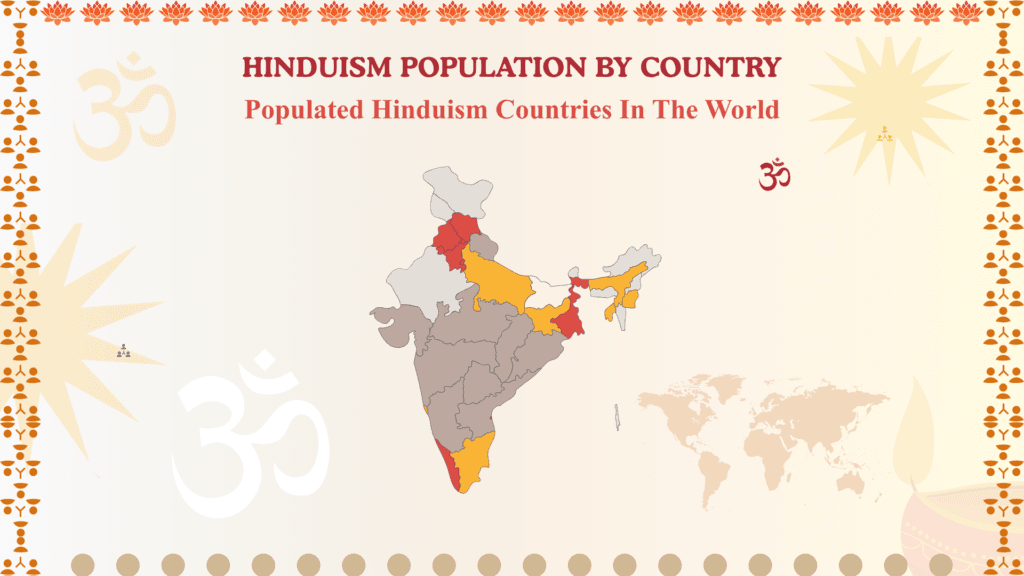
The overwhelming majority of the global Hinduism population by country resides within South Asia. India and Nepal alone account for roughly 97% of the world’s total Hindu population. In Nepal, Hinduism functions as the dominant cultural framework, yielding the highest percentage density of any nation. Significant minority populations in Bangladesh and Pakistan continue to represent deep archaeological and historical continuity within the region.
The Southeast Asian Enclaves
Outside of the immediate subcontinent, Indonesia presents a unique demographic anomaly. While Indonesia holds the world’s largest Muslim population, the island of Bali maintains a population that is over 80% Hindu, preserving an distinct iteration of the faith that evolved alongside local culture for centuries. Similarly, Malaysia and Singapore host robust Hindu populations stemming from historical migration pathways.
The Western Diaspora Networks
The expansion of the Hinduism population by country across the United States, Canada, and the United Kingdom is driven primarily by highly educated, professional migration over the last several decades. These communities are characterized by strong economic indicators and high levels of civic integration, making them critical cultural pillars within Western metropolitan zones.
Technical Challenges in Religious Demography
Accurately measuring the global Hindu population involves navigating complex socio-statistical variables:
Self-Identification Variations: Census methodologies often vary in how syncretic traditions (such as overlapping Buddhist-Hindu practices in parts of Southeast Asia) are categorized.
Census Interims: Many nations conduct comprehensive demographic surveys only once every decade, requiring statistical modeling to estimate intervening population growth.
Undocumented Diaspora Fluctuations: Rapidly shifting labor migration patterns in regions like the Middle East can create temporary but significant shifts in local counts.
Frequently Asked Questions
Which country possesses the highest percentage density of Hindus?
While India has the largest absolute number of Hindu adherents, Nepal holds the highest percentage density globally, with over 81% of its population identifying as Hindu.
Why is there a notable Hindu population in Caribbean nations like Guyana and Suriname?
The presence of Hinduism in the Caribbean is a result of 19th-century colonial labor systems. Following the abolition of slavery, vast numbers of Indian indentured laborers migrated to Guyana, Suriname, and Trinidad & Tobago, establishing permanent cultural communities.
How does migration influence the global ranking of the Hinduism population by country?
Modern economic and professional opportunities have caused western nations like the United States and Canada to climb the global rankings rapidly, driven by the growth of highly skilled diaspora communities.
Are the total numbers for the global Hindu population stable?
The baseline numbers grow in tandem with global population trends, but regional distributions shift continuously due to international migration patterns, particularly from South Asia to North America and the Middle East.