
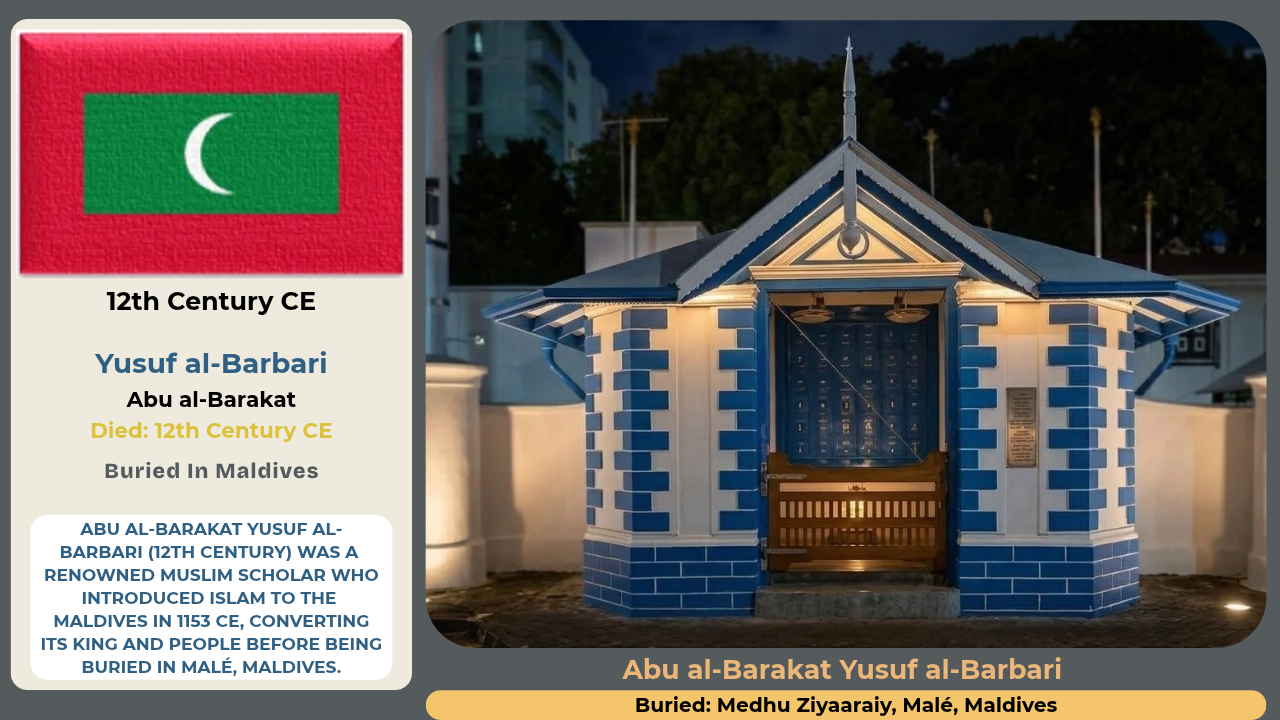
Abu al-Barakat Yusuf al-Barbari biography

Abu al-Barakat Yusuf al-Barbari
Twelfth-century Muslim scholar and travele credited
with converting the Maldivian king and islands
to Islam through Quranic recitation.

Abu al-Barakat Yusuf al-Barbari Burial Place Located
Abu al-Barakat Yusuf al-Barbari: Biography, Conversion of the Maldives to Islam, Historical Accounts and Mausoleum
Introduction
Abu al-Barakat Yusuf al-Barbari is traditionally remembered as the Muslim scholar and preacher associated with the conversion of the Maldives to Islam during the 12th century. According to the widely known Maldivian account, he arrived in the islands from North Africa, introduced Islamic teachings to the royal court and persuaded the Buddhist ruler to embrace Islam in 548 AH / 1153 CE.
His story occupies a special place in Maldivian history. The traditional narrative describes a religious traveller who confronted a terrifying sea spirit known as Rannamaari by reciting verses from the Holy Qur’an. The event is said to have convinced the king and his people to abandon their former religious practices and accept Islam.
The historical record, however, is more complicated than the popular story suggests. The Moroccan traveller Ibn Battuta recorded the account of Abu al-Barakat al-Barbari in the 14th century, but an alternative Maldivian chronicle and an early mosque inscription associate the conversion with a scholar identified as Yusuf Shams al-Din or Abu al-Barakat Yusuf al-Tabrizi. Some researchers have also considered whether the name al-Barbari referred to a connection with the Berber regions of North Africa or possibly the Somali coast.
Despite these uncertainties, Abu al-Barakat remains one of the most important figures in the traditional religious history of the Maldives. His name is associated with the beginning of the Islamic sultanate, the establishment of Muslim religious institutions and the long-term transformation of Maldivian society.
Basic Information About Abu al-Barakat Yusuf al-Barbari
| Category | Information |
|---|---|
| Common name | Abu al-Barakat Yusuf al-Barbari |
| Alternative name | Abu al-Barakat al-Maghribi |
| Name in some historical records | Abu al-Barakat Yusuf al-Tabrizi |
| Religious identity | Muslim scholar and preacher |
| Historical period | 12th century |
| Traditional arrival/conversion date | 548 AH / 1153 CE |
| Traditional geographical origin | Maghreb or North Africa |
| Alternative origin theory | Tabriz or the wider Persian region |
| Historical association | Introduction of Islam to the Maldives |
| Ruler associated with the conversion | Dhovemi, later Sultan Muhammad al-Adil |
| Main location | Malé, Maldives |
| Traditional conversion story | Rannamaari legend |
| Religious school associated with the early conversion | Maliki tradition, according to Ibn Battuta’s account |
| Traditional resting place | Medhu Ziyaaraiy, Malé |
| Historical certainty | Identity and origin remain debated |
Note: The dates, geographical origin and personal details of Abu al-Barakat are not as well documented as those of later historical scholars. The table presents the traditional identification and the principal historical alternatives.
Historical Background: The Maldives Before Islam
Before the establishment of the Islamic sultanate, Buddhism was the dominant organised religion in the Maldives. Archaeological discoveries across the islands have revealed Buddhist stupas, monasteries, sculptures and other remains that demonstrate the importance of Buddhist religious culture in the earlier history of the archipelago.
The Maldives occupied an important position along Indian Ocean trading routes. Its location between the Arabian Peninsula, the western coast of India and Southeast Asia brought it into contact with merchants, sailors and travellers from different parts of the region.
Arab and Persian merchants visited the islands because of their commercial importance, particularly the trade in cowrie shells, which were used as currency in several parts of the world.
These commercial connections also created opportunities for the gradual introduction of Islam. Muslim merchants and travellers could establish relationships with local communities, introduce Islamic religious practices and encourage conversion through trade, marriage and personal interaction.
The conversion of the Maldivian ruler in the 12th century therefore took place within a wider Indian Ocean environment in which Muslim commercial and religious networks were already active.
Abu al-Barakat Yusuf al-Barbari and His Arrival in the Maldives
According to the traditional account, Abu al-Barakat Yusuf al-Barbari was a Muslim traveller who arrived in the Maldives during the 12th century.
Ibn Battuta, who visited the Maldives in the 14th century, described him as a Maghribi, meaning a person from the western Islamic lands of North Africa. The name al-Barbari is also commonly associated with the Berber peoples of the Maghreb.
In the traditional narrative, Abu al-Barakat was a religiously devoted man who possessed extensive knowledge of the Qur’an. His arrival in Malé is associated with the events that eventually led to the conversion of the Maldivian ruler.
However, no dependable contemporary biography establishes his exact birthplace, family background, date of birth, teachers or early education. It is therefore not possible to provide a verified account of his childhood or scholarly training.
His historical importance comes primarily from his association with the conversion of the Maldives rather than from a surviving collection of books or a detailed personal biography.
The Conversion of the Maldives to Islam in 1153 CE
The traditional date associated with the conversion of the Maldives is 548 AH, corresponding to 1153 CE.
At that time, the islands were ruled by a Buddhist king. According to the historical tradition, the ruler accepted Islam and adopted the Muslim name Muhammad al-Adil.
This event marked the beginning of the Muslim sultanate and a major turning point in Maldivian political and religious history.
The conversion is traditionally attributed to Abu al-Barakat Yusuf al-Barbari. However, the exact identity of the preacher and the circumstances of the conversion remain disputed.
The Rannamaari Legend
The most famous account of Abu al-Barakat is the story of Rannamaari.
According to the traditional narrative, the people of Malé believed that a terrifying supernatural being emerged from the sea at regular intervals. The creature supposedly demanded that a young woman be offered as a sacrifice.
The community was frightened by the recurring event and believed that refusing the demand would bring disaster.
When Abu al-Barakat learned that a young woman from the household where he was staying had been selected, he reportedly offered to take her place.
The story describes him entering the place associated with the sacrifice and spending the night reciting verses from the Holy Qur’an.
By the following morning, the people reportedly discovered that he was unharmed and that the supernatural threat had disappeared.
The incident attracted the attention of the ruler, who invited the Muslim traveller to explain his religious beliefs. According to the legend, the king subsequently accepted Islam, followed by members of his court and the wider population.
The story became an important part of Maldivian cultural memory and is still widely associated with the introduction of Islam to the islands.
Historical Assessment of the Rannamaari Story
The Rannamaari account is historically significant as a traditional explanation of the conversion, but its supernatural details cannot be independently verified.
Ibn Battuta recorded a version of the story more than a century after the traditional conversion date. His account reflects information that was being told in the Maldives during his visit.
It should therefore be treated as an important medieval report of local tradition rather than as independent proof that every detail occurred exactly as narrated.
The wider conversion of the Maldives was likely connected with several factors, including Indian Ocean trade, the influence of Muslim merchants, political decisions by the ruling family and the gradual establishment of Islamic institutions.
Who Was the Ruler Who Accepted Islam?
The ruler traditionally associated with the conversion was Dhovemi, who is also identified in Maldivian historical traditions by royal titles connected with his pre-Islamic reign.
After embracing Islam, he became known as Sultan Muhammad al-Adil.
His conversion is traditionally dated to 548 AH / 1153 CE, and he is regarded as the first Muslim sultan of the Maldives.
The establishment of the sultanate transformed the political and religious identity of the islands.
Islam became the foundation of royal authority, public religious life and the legal institutions that developed under subsequent rulers.
The conversion also encouraged the construction of mosques, the appointment of Muslim religious officials and the spread of Islamic practices across the different atolls.
Abu al-Barakat al-Barbari or Yusuf al-Tabrizi? The Historical Debate
One of the most important questions concerning Abu al-Barakat is whether the preacher was originally from North Africa or Persia.
The disagreement arises from differences between Ibn Battuta’s account, Maldivian historical traditions and an early Arabic inscription associated with the main mosque in Malé.
1. The Maghribi or Berber Identification
Ibn Battuta identified the preacher as Abu al-Barakat al-Barbari al-Maghribi.
The term al-Maghribi indicates a connection with the western Islamic lands, particularly North Africa. The name al-Barbari is commonly understood as referring to a Berber or North African background.
This identification supports the traditional description of Abu al-Barakat as a traveller from the Maghreb.
Ibn Battuta also reported that the Maldivians followed the Maliki school of Islamic jurisprudence, a school historically prominent in North Africa.
These details have been used to support the North African identification.
2. The Persian Identification: Yusuf Shams al-Din Tabrizi
An alternative account appears in the Maldivian Ta’rikh, a later historical chronicle that attributes the conversion to a Persian religious figure named Maulana Shaykh Yusuf Shams al-Din Tabrizi.
In this version, the preacher came from Tabriz and persuaded the ruler to accept Islam through religious instruction and extraordinary spiritual events.
The chronicle presents him as a respected religious scholar whose knowledge and spiritual reputation influenced the royal court.
This account differs from Ibn Battuta’s identification of the preacher as al-Barbari.
3. Evidence from the Old Friday Mosque Inscription
An important piece of evidence discussed by historian Andrew D. W. Forbes is an Arabic inscription associated with the historic Friday Mosque in Malé.
The inscription, dated 738 AH / 1338 CE, reportedly states that Abu al-Barakat Yusuf al-Tabrizi arrived in the country and that the sultan accepted Islam through him in Rabi al-Akhir 548 AH.
This inscription is particularly important because it predates Ibn Battuta’s visit to the Maldives.
However, the difference between the names al-Tabrizi and al-Barbari has not been conclusively resolved. The inscription and Ibn Battuta’s account may reflect different traditions, a textual misunderstanding or confusion in the transmission of names.
4. Could He Have Come from the Somali Coast?
Some modern discussions have suggested that the name al-Barbari might indicate a connection with Berbera, an important historic port on the northwestern coast of present-day Somalia.
This interpretation is based on the geographical and commercial importance of Berbera and its connections with the wider Indian Ocean world.
It is a possibility discussed in modern scholarship, but it is not an established fact about Abu al-Barakat’s birthplace.
The evidence does not allow a definitive conclusion that he was Somali, Moroccan or Persian.
Which Identification Is Most Reliable?
The available historical evidence supports several conclusions:
- Ibn Battuta’s account identifies the preacher as a Maghribi called Abu al-Barakat al-Barbari.
- The Maldivian Ta’rikh gives an alternative Persian identification connected with Yusuf Shams al-Din Tabrizi.
- An Arabic inscription discussed by Andrew D. W. Forbes uses the name Abu al-Barakat Yusuf al-Tabrizi.
- The exact relationship between these accounts remains unresolved.
For this reason, the most historically responsible approach is to retain the familiar name Abu al-Barakat Yusuf al-Barbari while explaining that his origin and identification are disputed.
Religious School and the Introduction of Islamic Practices
Ibn Battuta reported that the Maldivians followed the Maliki school of Islamic jurisprudence during his visit in the 14th century.
The Maliki school was historically influential in North Africa and parts of the western Islamic world.
This observation has been used to support the traditional view that the early preacher came from the Maghreb.
However, the religious history of the Maldives changed over subsequent centuries. The Shafi’i school eventually became dominant and remains the principal school of jurisprudence associated with Maldivian Sunni Islam.
The development of Islamic practice in the islands was therefore a gradual historical process rather than an immediate and complete transformation at the moment of the ruler’s conversion.
The establishment of mosques, religious education, Islamic legal administration and connections with foreign Muslim scholars helped consolidate Islam over time.
Establishment of the First Muslim Sultanate
The conversion of the ruler in 548 AH / 1153 CE is traditionally regarded as the beginning of the Maldivian Muslim sultanate.
Sultan Muhammad al-Adil became associated with the new Islamic political order.
The adoption of Islam affected the monarchy, the administration of the islands and the religious identity of the population.
The sultanate developed institutions based on Islamic law and Muslim political traditions. Royal authority became closely connected with the ruler’s status as a Muslim sovereign.
The conversion also encouraged the construction and maintenance of mosques and the development of religious education.
The Maldives remained under various forms of sultanate rule for centuries, although the political structure and succession arrangements changed over time.
Abu al-Barakat’s traditional role is therefore associated with a major transformation that shaped the country’s subsequent history.
Mosque of Abu al-Barakat and the Religious Heritage of Malé
The introduction of Islam to the Maldives was followed by the establishment of mosques and other religious institutions.
The historic Friday Mosque in Malé, commonly known as Hukuru Miskiy or the Old Friday Mosque, is particularly important in the religious and architectural history of the country.
The mosque has undergone reconstruction and development over different periods. Its inscriptions and architectural features provide evidence of the long history of Islam in the Maldives.
Ibn Battuta reported that Abu al-Barakat built a mosque associated with his name. The exact relationship between that early mosque and the surviving historic structures requires care, because the main Friday Mosque was rebuilt in later centuries.
The religious buildings of Malé became central to the development of Islamic worship, education and public life.
Family, Marriage and Children
Very little reliable historical information survives about the personal family life of Abu al-Barakat Yusuf al-Barbari.
The principal medieval accounts focus on his religious activities and the conversion of the Maldives rather than his parents, marriage or descendants.
No dependable scholarly source establishes the names of his father, mother, wife or children.
It is also not possible to confirm whether he remained in the Maldives permanently, travelled elsewhere after the conversion or established a family there.
For historical accuracy, claims about his family tree or direct descendants should not be presented as established facts without additional documentary evidence.
Teachers, Students and Religious Successors
The surviving accounts do not provide a verified list of Abu al-Barakat’s teachers or students.
Unlike major Sufi masters whose spiritual lineages were carefully recorded by their followers, Abu al-Barakat is primarily known through the conversion tradition preserved in medieval and later Maldivian sources.
There is no securely established record of a Sufi order founded by him or a documented chain of spiritual successors.
His historical importance should therefore be understood through his traditional role in the Islamisation of the Maldives rather than through an unsupported claim that he founded a particular Sufi lineage.
Books and Literary Works
No authenticated book or surviving literary collection is securely attributed to Abu al-Barakat Yusuf al-Barbari.
He is remembered mainly as a travelling Muslim preacher and religious figure associated with the conversion of the Maldives.
The Qur’an occupies a central place in the Rannamaari story, in which he is said to have recited its verses during the night of the supposed supernatural encounter.
However, this traditional account does not establish that he wrote a Qur’anic commentary, legal treatise, Sufi manual or other independent literary work.
It is therefore more accurate to describe him as a figure remembered for religious preaching than as a documented author.
Relationship with the Maldivian Rulers
Abu al-Barakat’s traditional historical role is closely connected with the ruler who accepted Islam in 548 AH / 1153 CE.
The ruler is commonly identified as Dhovemi, who became Sultan Muhammad al-Adil after his conversion.
According to the traditional narrative, the preacher’s religious influence persuaded the king to abandon Buddhism and establish a Muslim sultanate.
The relationship is remembered as an important example of religious influence upon political authority in the medieval Indian Ocean world.
However, there is no reliable evidence that Abu al-Barakat became a political ruler, military commander or long-term royal administrator.
His place in history rests on his association with the religious transformation of the islands.
Death and Resting Place of Abu al-Barakat
The exact date of Abu al-Barakat’s death is not securely established in the principal historical accounts.
Traditional Maldivian memory associates him with a shrine in Malé known as Medhu Ziyaaraiy, often translated as the Central Shrine.
The shrine is attached to the religious heritage surrounding Medhu Miskiy, or the Central Mosque, in the historic capital.
Andrew D. W. Forbes discusses the burial tradition in his historical survey of Maldivian mosques. He notes that Abu al-Barakat was believed to be buried at the Medu Ziyaaraiy associated with the Medu Miskit.
This makes Malé the principal location associated with his traditional resting place.
Exact Traditional Resting Place
| Category | Location |
|---|---|
| Name | Medhu Ziyaaraiy |
| Associated mosque | Medhu Miskiy / Central Mosque |
| City | Malé |
| Administrative region | Malé |
| Country | Maldives |
| Historical association | Traditional burial place of Abu al-Barakat |
| Death date | Not reliably established |
The shrine is an important part of the traditional memory of the introduction of Islam to the Maldives. Nevertheless, the burial identification should be described as a local historical tradition rather than as an independently proven archaeological identification.
Spread of Islam Across the Maldivian Islands
The conversion of the ruler did not mean that every island adopted Islam at precisely the same moment.
The traditional account describes the king sending representatives to other islands to encourage or enforce conversion.
The spread of Islam across the archipelago would have involved communication between the royal centre, local communities, merchants and religious figures.
Mosques and religious teachers gradually became important institutions in the islands.
The introduction of Islamic practices affected several aspects of Maldivian society:
Religious life: Islamic worship, fasting, pilgrimage and Qur’anic recitation became central to public and private religious practice.
Political authority: The ruler’s legitimacy became connected with the Islamic sultanate.
Legal administration: Islamic legal principles increasingly influenced the administration of the country.
Education: Mosques and religious teachers helped establish Islamic learning.
International relations: The Maldives developed closer religious and commercial connections with Muslim societies around the Indian Ocean.
The process continued over generations, shaping the religious identity of the country.
Historical Timeline of Abu al-Barakat and the Islamisation of the Maldives
| Date | Historical event |
|---|---|
| Before the 12th century | Buddhism is the dominant organised religion in the Maldives |
| 12th century | Muslim merchants and travellers are active in Indian Ocean trade networks |
| 548 AH / 1153 CE | Traditional date for the conversion of the Maldivian ruler to Islam |
| 548 AH / 1153 CE | Dhovemi is associated with the beginning of the Muslim sultanate as Sultan Muhammad al-Adil |
| 14th century | Ibn Battuta visits the Maldives and records the al-Barbari conversion account |
| 738 AH / 1338 CE | An Arabic inscription discussed by Andrew D. W. Forbes records the name Abu al-Barakat Yusuf al-Tabrizi |
| 17th–18th centuries | The Maldivian Ta’rikh preserves an alternative account involving Yusuf Shams al-Din Tabrizi |
| Modern period | Historians continue to examine the different accounts of the conversion |
Legacy and Historical Importance
Abu al-Barakat Yusuf al-Barbari occupies an important position in the traditional history of Islam in the Maldives.
His legacy is associated with several major developments.
1. Introduction of Islam: He is traditionally credited with persuading the Maldivian ruler to accept Islam in 1153 CE.
2. Beginning of the Muslim sultanate: His name is connected with the political transformation that followed the conversion of the ruler.
3. Rannamaari tradition: The story of his encounter with the sea spirit became one of the most recognisable religious legends in Maldivian culture.
4. Historical identity: His traditional role became part of the Maldives’ national narrative about the establishment of Islam.
5. Religious heritage of Malé: The shrine associated with his name remains connected with the traditional memory of the country’s conversion.
6. Indian Ocean connections: His story reflects the wider movement of Muslim merchants, travellers and religious figures across the Indian Ocean.
7. Historical research: The disagreement between the al-Barbari and al-Tabrizi accounts continues to attract scholarly interest in Maldivian history.
Conclusion
Abu al-Barakat Yusuf al-Barbari is traditionally remembered as the Muslim preacher who helped introduce Islam to the Maldives during the 12th century. His name is closely associated with the conversion of the Maldivian ruler in 548 AH / 1153 CE and the beginning of the Muslim sultanate.
The famous Rannamaari story describes his recitation of the Qur’an and the disappearance of a supernatural threat, after which the ruler and his people reportedly embraced Islam. Although the story is an important part of Maldivian cultural memory, its supernatural details cannot be independently verified.
Historical research also reveals a significant debate about his identity. Ibn Battuta described him as a Maghribi or Berber, while a Maldivian chronicle and an early mosque inscription connect the conversion with Yusuf Shams al-Din or Abu al-Barakat Yusuf al-Tabrizi.
His exact birthplace, family, teachers, writings and death date remain uncertain. His traditional resting place is associated with Medhu Ziyaaraiy in Malé, Maldives.
Despite the unanswered questions, Abu al-Barakat remains an important figure in the religious history of the Maldives and in the wider story of Islam’s expansion through Indian Ocean trade and travel.
Frequently Asked Questions About Abu al-Barakat Yusuf al-Barbari
1. Who was Abu al-Barakat Yusuf al-Barbari?
He was a Muslim preacher traditionally credited with introducing Islam to the Maldives and converting its ruler during the 12th century.
2. When did Abu al-Barakat Yusuf al-Barbari introduce Islam to the Maldives?
The traditional date is 548 AH, corresponding to 1153 CE.
3. Where did Abu al-Barakat Yusuf al-Barbari come from?
Ibn Battuta described him as a Maghribi, suggesting a North African origin. Other historical traditions identify the preacher as Yusuf Shams al-Din Tabrizi, associated with Persia. His exact origin remains disputed.
4. Who was the first Muslim ruler of the Maldives?
The first Muslim ruler is traditionally identified as Dhovemi, who adopted the Muslim name Sultan Muhammad al-Adil after his conversion.
5. What is the Rannamaari story?
It is a Maldivian conversion legend about a supernatural sea spirit that supposedly demanded a young woman as a sacrifice. Abu al-Barakat is said to have confronted the threat by reciting the Qur’an.
6. Is the Rannamaari story historically proven?
No. It is an important traditional narrative recorded in medieval accounts, but its supernatural details cannot be independently verified.
7. Was Abu al-Barakat Moroccan or Persian?
The evidence is disputed. Ibn Battuta identifies him as al-Barbari al-Maghribi, while an early inscription and a later Maldivian chronicle use the name al-Tabrizi or identify a Persian preacher.
8. Who was Yusuf Shams al-Din Tabrizi?
He is the religious figure credited with the conversion of the Maldives in an alternative Maldivian historical tradition. Some records connect his name with the inscription associated with the old Friday mosque.
9. Where is Abu al-Barakat Yusuf al-Barbari buried?
His traditional resting place is identified as Medhu Ziyaaraiy, associated with Medhu Miskiy in Malé, Maldives.
10. Did Abu al-Barakat write any books?
No authenticated books are securely attributed to him in the principal historical sources.
11. Who were Abu al-Barakat’s teachers?
The surviving historical accounts do not provide a reliable list of his teachers.
12. Did Abu al-Barakat establish a Sufi order?
There is no reliable historical evidence that he founded a specific Sufi order or left a documented spiritual succession.
13. Which Islamic school was followed in the Maldives after the conversion?
Ibn Battuta reported that the Maldivians followed the Maliki school during his 14th-century visit. The Shafi’i school later became dominant.
14. Why is Abu al-Barakat important in Maldivian history?
He is traditionally credited with converting the ruler to Islam, an event associated with the establishment of the Muslim sultanate and the transformation of Maldivian religious and political life.
15. Is Abu al-Barakat’s birthplace and family known?
No dependable historical record establishes his exact birthplace, parents, marriage or children. Claims about these details should be treated cautiously.
Abu al-Barakat Yusuf al-Barbari – Sources
- Andrew D. W. Forbes – The Mosque in the Maldive Islands: A Preliminary Historical Survey — Academic research on the history of Maldivian mosques, the conversion traditions, Ibn Battuta’s account, and the competing identifications of al-Barbari and al-Tabrizi.
- Ibn Battuta – The Travels of Ibn Battuta, translated by H. A. R. Gibb and others — Medieval account describing Abu al-Barakat, the Rannamaari story, and the conversion of the Maldivian ruler.
- H. C. P. Bell – The Maldive Islands: Monograph on the History, Archaeology and Epigraphy —The Maldive Islands: Monograph on the History, Archaeology and Epigraphy Historical and archaeological research covering early Islam in the Maldives, inscriptions, and alternative conversion traditions.
- Andrew D. W. Forbes and RelatedHistory of the Maldives Scholarship – Archives and Resources for Maldivian History — Research resources for reconstructing the early history of the Maldives.
- Maldives Traveller – History of the Maldives — General historical overview of the Rannamaari tradition and the role attributed to Abu al-Barakat.
- Ibrahim Hazum – Maldives Legal and Political History, ISLR Paper Series (2023) — Research on the early political and legal development of the Maldives and traditional accounts of its conversion to Islam.
- Latifa Babas – When Moroccan Merchant Abu al-Barakat Yusuf al-Barbari Converted the Maldives to Islam, Yabiladi — Modern overview of the Moroccan identification and the traditional conversion narrative.
- Rizwan A. Ahmad – Perspectives on Modern South Asia — Discusses competing accounts identifying the religious figure credited with introducing Islam to the Maldives, including the significance of the 1338 mosque inscription.