
North America continent statistics
North America by the Numbers: Countries, Regions & Area Explained
Countries & Regions: North America spans 3+ regions and has 41 countries and territories, including 23 sovereign states. Source: World Population Review
Population: North America’s population is 621,248,040, based on UN World Population Prospects data. Source: Our World in Data
Area: North America covers about 24.7 million km², ranking third among continents by land area. Source: Encyclopaedia Britannic
how many countries are there in North America
north america countries by population
| Rank | Country | 2025 Population | Land Area (Km²) | Density (P/Km²) |
|---|---|---|---|---|
| 1 | United States | 347,275,807 | 9,147,420 | 38 |
| 2 | Mexico | 131,946,900 | 1,943,950 | 68 |
| 3 | Canada | 40,126,723 | 9,093,510 | 4 |
| 4 | Guatemala | 18,687,881 | 107,160 | 174 |
| 5 | Haiti | 11,906,095 | 27,560 | 432 |
| 6 | Dominican Republic | 11,520,487 | 48,320 | 238 |
| 7 | Honduras | 11,005,850 | 111,890 | 98 |
| 8 | Cuba | 10,937,203 | 106,440 | 103 |
| 9 | Nicaragua | 7,007,502 | 120,340 | 58 |
| 10 | El Salvador | 6,365,503 | 20,720 | 307 |
| 11 | Costa Rica | 5,152,950 | 51,060 | 101 |
| 12 | Panama | 4,571,189 | 74,340 | 61 |
| 13 | Puerto Rico | 3,235,289 | 8,870 | 365 |
| 14 | Jamaica | 2,837,077 | 10,830 | 262 |
| 15 | Trinidad and Tobago | 1,511,155 | 5,130 | 295 |
| 16 | Belize | 422,924 | 22,810 | 19 |
| 17 | Bahamas | 403,033 | 10,010 | 40 |
| 18 | Guadeloupe | 373,791 | 1,690 | 221 |
| 19 | Martinique | 340,439 | 1,060 | 321 |
| 20 | Barbados | 282,623 | 430 | 657 |
| 21 | Curaçao | 185,487 | 444 | 418 |
| 22 | Saint Lucia | 180,149 | 610 | 295 |
| 23 | Grenada | 117,303 | 340 | 345 |
| 24 | Aruba | 108,147 | 180 | 601 |
| 25 | St. Vincent & Grenadines | 99,924 | 390 | 256 |
| 26 | Antigua and Barbuda | 94,209 | 440 | 214 |
| 27 | U.S. Virgin Islands | 84,138 | 350 | 240 |
| 28 | Cayman Islands | 75,844 | 240 | 316 |
| 29 | Dominica | 65,871 | 750 | 88 |
| 30 | Bermuda | 64,555 | 50 | 1,291 |
| 31 | Greenland | 55,745 | 410,450 | 0 |
| 32 | Saint Kitts & Nevis | 46,922 | 260 | 180 |
| 33 | Turks and Caicos | 46,855 | 950 | 49 |
| 34 | St. Maarten | 43,923 | 34 | 1,292 |
| 35 | British Virgin Islands | 39,732 | 150 | 265 |
| 36 | Caribbean Netherlands | 31,338 | 328 | 96 |
| 37 | Anguilla | 14,728 | 90 | 164 |
| 38 | St. Barthelemy | 11,414 | 21 | 544 |
| 39 | St. Pierre & Miquelon | 5,574 | 230 | 24 |
| 40 | Montserrat | 4,359 | 100 | 44 |
| Source: | Geocountries | Population Statistics - North America Countries | |||
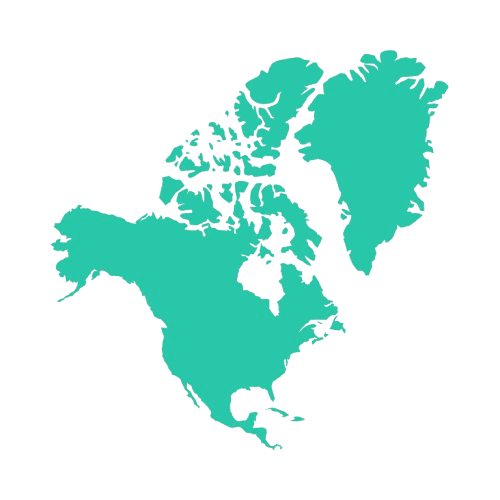
North America Continent Overview
Introduction to North America
North America is the world’s third-largest continent, covering 24.2 million km² (16.28%) of Earth’s land area. It comprises 41 countries and territories across 4 regions and is home to 621.2 million people, accounting for 7.49% of the global population. The continent has an average population density of 26 people per km² and grows by approximately 4 million people each year.
Capital Cities of North America by Population
| S no. | country | city | population |
|---|---|---|---|
| 1 | Mexico | Mexico City | 9,020,812 |
| 2 | Haiti | Port-au-Prince | 1,633,591 |
| 3 | Cuba | Havana | 1,583,433 |
| 4 | Canada | Ottawa | 1,218,903 |
| 5 | Honduras | Tegucigalpa | 1,176,079 |
| 6 | Panama | Panama City | 1,150,444 |
| 7 | Nicaragua | Managua | 1,064,326 |
| 8 | Dominican Republic | Santo Domingo | 1,001,525 |
| 9 | Guatemala | Guatemala City | 914,057 |
| 10 | United States | Washington | 698,733 |
| 11 | Costa Rica | San Jose | 364,062 |
| 12 | El Salvador | San Salvador | 333,295 |
| 13 | Bahamas | Nassau | 315,729 |
| 14 | Puerto Rico | San Juan | 291,890 |
| 15 | Martinique | Fort-de-France | 74,040 |
| 16 | Jamaica | Kingston | 73,019 |
| 17 | Barbados | Bridgetown | 72,807 |
| 18 | Antigua and Barbuda | St. John | 61,620 |
| 19 | Saint Lucia | Castries | 59,021 |
| 20 | Grenada | St. George's | 47,418 |
| 21 | Cayman Islands | George Town | 38,350 |
| 22 | British Virgin Islands | Road Town | 33,369 |
| 23 | Aruba | Oranjestad | 28,876 |
| 24 | Trinidad and Tobago | Port of Spain | 25,324 |
| 25 | Belize | Belmopan | 22,956 |
| 26 | Greenland | Nuuk | 20,298 |
| 27 | United States Virgin Islands | Charlotte Amalie | 17,809 |
| 28 | Dominica | Roseau | 14,987 |
| 29 | Saint Vincent and the Grenadines | Kingstown | 11,796 |
| 30 | Saint Kitts and Nevis | Basseterre | 11,764 |
| 31 | Guadeloupe | Basse-Terre | 9,043 |
| 32 | Turks and Caicos Islands | Cockburn Town | 6,190 |
| 33 | Saint Pierre and Miquelon | Saint-Pierre | 5,113 |
| 34 | Saint Martin | Marigot | 3,246 |
| 35 | Saint Barthelemy | Gustavia | 2,754 |
| 36 | Sint Maarten | Philipsburg | 2,417 |
| 37 | Montserrat | Plymouth | 1,478 |
| 38 | Curacao | Willemstad | 1,312 |
| 39 | Anguilla | The Valley | 1,174 |
| 40 | Bermuda | Hamilton | 779 |
Population History of North America
| S no. | Year | Population | Change |
|---|---|---|---|
| 1 | 2026 | 621,248,040 | 0.64% |
| 2 | 2025 | 617,280,241 | 0.63% |
| 3 | 2020 | 598,223,766 | 0.88% |
| 4 | 2015 | 572,612,251 | 1.05% |
| 5 | 2010 | 543,572,278 | 1.13% |
| 6 | 2005 | 513,781,515 | 1.13% |
| 7 | 2000 | 485,790,426 | 1.19% |
| 8 | 1995 | 457,844,575 | 1.38% |
| 9 | 1990 | 427,514,565 | 1.32% |
| 10 | 1985 | 400,458,672 | 1.36% |
| 11 | 1980 | 374,384,190 | 1.40% |
| 12 | 1975 | 349,213,207 | 1.56% |
| 13 | 1970 | 323,215,591 | 1.70% |
| 14 | 1965 | 297,047,232 | 2% |
| 15 | 1960 | 269,071,653 | 1.97% |
| 16 | 1955 | 244,048,382 | 1.84% |
| 17 | 1950 | 222,811,384 | 2.63% |
| 18 | 1945 | 195,674,642 | 1.65% |
| 19 | 1940 | 180,273,049 | 1.05% |
| 20 | 1935 | 171,071,933 | 1.02% |
| 21 | 1930 | 162,631,140 | 1.45% |
| 22 | 1925 | 151,328,781 | 1.50% |
| 23 | 1920 | 140,480,385 | 1.35% |
| 24 | 1915 | 131,357,719 | 1.36% |
| 25 | 1910 | 122,778,722 | 1.77% |
| 26 | 1905 | 112,446,137 | 1.81% |

Population in North America by religion

Christianity in North America
Christianity is the largest religion in North America, representing 63% of the region's population in 2020 and remaining widely practiced.

Atheist Population
Religiously unaffiliated people account for 30% of North America's population, including atheists, agnostics and those with no religion.

Islam in North America
Islam is practiced by about 6 million people in North America, making Muslims a growing religious community across the region today.

Judaism in North America
Judaism is practiced by a smaller share of North America's population, with Jewish people accounting for less than 2% of the region.
Most Spoken Languages in North America
Languages Spoken Across the Continent
North America is one of the world’s most linguistically diverse continents, with English being the most spoken language at approximately 334 million speakers, followed by Spanish with around 125 million, French with about 18 million, Chinese with approximately 4.6 million, Tagalog with 2 million, Vietnamese with 1.5 million, German and Arabic with roughly 1.3 million each, Korean with about 1.2 million, and Italian with approximately 1 million speakers.
334 million speakers Of English
125 Million Spanish speakers
French 18 Million approximately
Tagalog 2 Million million speakers
North America: Population, Regions, Religion, and Geography Explained
North America is the third-largest continent on Earth by land area, stretching nearly 8,000 kilometers from the Arctic ice sheets of northern Canada and Greenland down to the tropical lowlands of Panama. It is home to roughly 600 million people spread across 23 sovereign countries and dozens of dependent territories, making it one of the most geographically and culturally varied continents on the planet.
This guide covers the continent’s population, regional divisions, religious composition, languages, and physical geography — with every figure traced back to its original source, so you can verify the data yourself rather than take it on faith.
Where North America Sits on the Map
North America occupies the northern and western hemispheres. It is bordered by:
- The Arctic Ocean to the north
- The Atlantic Ocean to the east
- The Pacific Ocean to the west
- South America and the Caribbean Sea to the southeast, connected by the narrow Isthmus of Panama
Because the continent spans such an extreme range of latitude — from just south of the North Pole to near the equator — it contains nearly every climate zone found on Earth within a single connected landmass, a distinction few other continents share.
How Big Is North America?
North America covers approximately 24.7 million square kilometers (about 9.5 million square miles), according to the UN Statistics Division’s geographic classification, making it the third-largest continent after Asia and Africa.
That size holds an unusually wide range of terrain:
- The Rocky Mountains, stretching from Alaska through the western United States, formed roughly 80 million years ago through a slow tectonic collision geologists call the Laramide Orogeny
- The Appalachian Mountains in the east, among the oldest mountain ranges on the planet at roughly 480 million years old, worn down over time into rounded, forested ridges
- The Canadian Shield, one of the most geologically stable and ancient rock formations on Earth
- The Great Plains, a vast fertile interior lowland shared by the U.S. and Canada
- The Great Lakes, the largest group of freshwater lakes on Earth by surface area, holding an estimated 21% of the world’s surface fresh water
- The Sonoran and Chihuahuan Deserts across the southwestern United States and northern Mexico
Denali, in Alaska, is the continent’s highest peak at 6,190 meters (20,310 feet).
Population of North America
North America is home to roughly 600 million people, according to UN World Population Prospects data, making it the fourth most populous continent after Asia, Africa, and Europe — a little over 7% of the world’s total population.
Population by country (approximate, based on UN estimates):
| Rank | Country | Approx. Population |
|---|---|---|
| 1 | United States | 347.27 million |
| 2 | Mexico | 131.94 million |
| 3 | Canada | 40.12 million |
| 4 | Guatemala | 18.68 million |
| 5 | Haiti | 11.90 million |
| 6 | Dominican Republic | 11.52 million |
| 7 | Honduras | 11.0 million |
| 8 | Cuba | 10.9 million |
| 9 | Nicaragua | 7.0 million |
| 10 | El Salvador | 6.3 million |
Figures are rounded estimates compiled from UN World Population Prospects. For country-specific detail, consult national statistical offices directly — e.g., the U.S. Census Bureau or Statistics Canada.
Key patterns:
- The United States and Mexico together account for roughly three-quarters of the continent’s total population.
- Population density varies enormously: northern Canada and Greenland are among the most sparsely populated places on Earth, while Mexico City, New York, and Los Angeles rank among the world’s densest urban centers.
- The large majority of North Americans live in cities and metropolitan areas rather than rural regions.
Regions of North America
The continent is generally divided into four major regions, though the exact grouping varies slightly by source:
1. Northern America
The United States and Canada, plus Greenland and smaller territories like Bermuda and Saint Pierre and Miquelon. Characterized by advanced economies and climates ranging from temperate to arctic.
2. Mexico
Sometimes grouped with Central America, sometimes treated as its own region — Mexico bridges North and Central America both geographically and culturally, with a population larger than every Central American country combined.
3. Central America
Seven countries form the narrow land bridge connecting North and South America: Guatemala, Belize, Honduras, El Salvador, Nicaragua, Costa Rica, and Panama. The region is known for tropical climates, exceptional biodiversity, and a strong blend of Indigenous and Spanish colonial heritage.
4. The Caribbean
Thousands of islands across the Caribbean Sea, including Cuba, Hispaniola (Haiti and the Dominican Republic), Jamaica, Puerto Rico, and Trinidad and Tobago — shaped by tourism-driven economies and a distinct Afro-Caribbean, Indigenous, and European cultural mix.
For the official basis of how these regional boundaries are drawn, see the UN Statistics Division’s M49 geoscheme, which is the authoritative reference for continental and subregional classification.
Religion in North America
North America’s religious makeup reflects centuries of colonization, migration, and cultural exchange. According to Pew Research Center’s Religious Composition by Country data, Christianity remains the majority faith across most of the continent, though the picture is far from uniform:
- Christianity is the majority religion, split broadly between Protestantism — more common in the United States and English-speaking Canada — and Roman Catholicism, dominant in Mexico, Central America, and much of the Caribbean, largely a legacy of Spanish and French colonization.
- Religiously unaffiliated populations (atheists, agnostics, and those with no formal religion) have grown steadily in recent decades, particularly in the United States and Canada, driven largely by younger generations moving away from organized religion.
- Minority religions — including Islam, Judaism, Hinduism, and Buddhism — are present throughout the continent, concentrated in large, diverse metropolitan areas shaped by immigration.
- Indigenous belief systems, practiced by Native American, First Nations, and Indigenous Mesoamerican communities, continue to hold cultural and spiritual significance even in regions where Christianity dominates.
For country-by-country percentages, the Pew Research religious composition dataset is the most reliable published source and is updated periodically.
Languages of North America
Colonization, migration, and Indigenous heritage have shaped a linguistic map that includes hundreds of distinct languages. According to Ethnologue, the most widely spoken are:
- English — the most widely spoken language on the continent, dominant in the United States and Canada
- Spanish — the second most-spoken, concentrated in Mexico, followed by the United States and Cuba
- French — spoken widely in Canada (especially Quebec) and Haiti
- Chinese varieties (including Mandarin) — spoken mainly by immigrant communities in the U.S. and Canada
- Smaller but significant populations of Tagalog, Vietnamese, German, Arabic, Korean, and Italian speakers, reflecting the continent’s immigrant diversity
Indigenous languages remain an important part of the linguistic landscape. Mexico alone is home to dozens, including Nahuatl and various Mayan languages. Navajo is among the most widely spoken Indigenous languages in the United States, and Cree holds that position in Canada — figures tracked in detail by Statistics Canada and the U.S. Census Bureau’s language-use data.
Climate and Natural Environment
North America’s extreme latitudinal range means it contains nearly every climate type on Earth:
- Arctic and subarctic climates across northern Canada, Alaska, and Greenland
- Temperate climates through most of the continental United States and southern Canada
- Arid and semi-arid climates across the southwestern United States and northern Mexico
- Tropical climates in southern Mexico, Central America, and the Caribbean
This range supports an equally wide spread of ecosystems — boreal forest across Canada and Alaska (one of the largest intact forest systems on Earth), temperate forest and grassland through the middle latitudes, and rainforest in Central America, home to jaguars, howler monkeys, and thousands of tropical bird species.
Human Development and Notable Rankings
Canada currently ranks first in North America on the UNDP Human Development Index, reflecting strong outcomes in health, education, and income — a ranking that places it among the top tier globally. HDI methodology and country-by-country scores are published directly by UNDP and updated annually, making it the most reliable reference for cross-country development comparisons on the continent.
Quick Facts Summary
| Category | Details |
|---|---|
| Continent rank (by size) | 3rd largest |
| Continent rank (by population) | 4th most populous |
| Approximate area | ~24.7 million km² |
| Approximate population | ~600 million |
| Major regions | Northern America, Mexico, Central America, the Caribbean |
| Dominant religion | Christianity (Protestant and Catholic) |
| Most spoken language | English, followed by Spanish |
| Bordering oceans | Arctic, Atlantic, Pacific |
| Highest point | Denali, Alaska (6,190 m / 20,310 ft) |
Frequently Asked Questions
What countries are part of North America? North America includes the United States, Canada, Mexico, Greenland, the seven countries of Central America (Guatemala, Belize, Honduras, El Salvador, Nicaragua, Costa Rica, Panama), and the island nations of the Caribbean, including Cuba, Jamaica, Haiti, and the Dominican Republic.
What is the population of North America? North America has a population of roughly 600 million people, according to UN data, making it the fourth most populous continent in the world.
What is the main religion in North America? Christianity is the dominant religion, split mainly between Protestantism (common in the U.S. and Canada) and Roman Catholicism (common in Mexico, Central America, and the Caribbean), per Pew Research Center.
What languages are spoken in North America? English and Spanish are the two most widely spoken, followed by French, especially in Canada and Haiti. The continent is also home to hundreds of Indigenous languages, including Nahuatl, Navajo, and Cree.
How many regions does North America have? North America is generally divided into four regions: Northern America, Mexico, Central America, and the Caribbean.
What is the largest country in North America by area? Canada is the largest by total area, followed closely by the United States.
What is the largest country in North America by population? The United States has the largest population, followed by Mexico and then Canada.
Is Mexico part of North America or Central America? Mexico is geographically and politically part of North America, though it is sometimes grouped culturally with Central America due to shared language and history.
Sources
- United Nations, World Population Prospects — population figures
- UN Statistics Division, M49 Geoscheme — continental and regional classification
- Pew Research Center, Religious Composition by Country — religion data
- Ethnologue — language and speaker-count data
- UNDP Human Development Reports — HDI rankings
- U.S. Census Bureau — U.S.-specific population and language data
- Statistics Canada — Canada-specific population and language data